The landscape of American higher education is undergoing a seismic shift. The traditional “one-size-fits-all” lecture hall model, which dominated the 20th century, is rapidly giving way to a more fluid, student-centric approach. As we move through 2026, personalized learning has moved from a progressive experiment to a foundational requirement for institutional success and student retention in the United States.
With rising tuition costs and a hyper-competitive job market, American students are increasingly demanding an educational experience that respects their unique backgrounds, learning speeds, and career aspirations.
The Rise of the “Student-as-Consumer” Model
In the US, the National Center for Education Statistics (NCES) has noted a significant diversification in the student demographic. Today’s learners are often “non-traditional,” balancing full-time work, family responsibilities, and remote learning needs. This shift has necessitated a move toward competency-based education (CBE). Unlike traditional models that measure progress by “seat time,” CBE allows students to advance once they master a specific skill, regardless of how long it takes.
This level of flexibility requires a robust support infrastructure. For many students navigating these rigorous, self-paced programs, utilizing a custom assignment service has become a strategic way to manage specific technical requirements while focusing their energy on core competency mastery. This allows for a more tailored academic journey, ensuring that high-stakes projects align with both grading rubrics and individual professional goals.
Data-Driven Insights: Why Personalization Works
Recent studies from EDUCAUSE and the Gates Foundation suggest that personalized learning paths can increase student engagement by up to 30%. By leveraging adaptive learning technologies, institutions can identify “at-risk” students much earlier in the semester.
- Adaptive Platforms: AI-driven platforms adjust the difficulty of content in real-time based on student performance.
- Targeted Intervention: Instructors can provide micro-feedback rather than waiting for mid-term results.
- Resource Allocation: Data allows universities to see exactly where students struggle—whether it’s organic chemistry or complex historical analysis.
The Role of Subject-Specific Support
Personalization isn’t just about software; it’s about deep-dive expertise. For instance, in the humanities, students are often asked to apply historical lessons to modern-day socio-economic issues. This requires a level of nuance that standard textbooks often lack. When a student struggles to connect the industrial revolution’s impact to today’s automation trends, seeking specialized history assignment help can provide the necessary context to turn a generic essay into a piece of rigorous scholarship. This targeted assistance ensures that the student’s personal learning gap is bridged without stalling their overall momentum.
See also: API Monetization Strategies
Key Takeaways for 2026
- Flexibility is King: US students prioritize programs that offer asynchronous learning and customizable schedules.
- Technology is the Enabler: Adaptive learning software and AI tutors are becoming standard in Ivy League and State schools alike.
- Focus on Mastery: The shift from “time-spent” to “skills-learned” is the primary driver of educational reform.
- Holistic Support: Success in a personalized environment requires a mix of institutional resources and specialized external academic support.
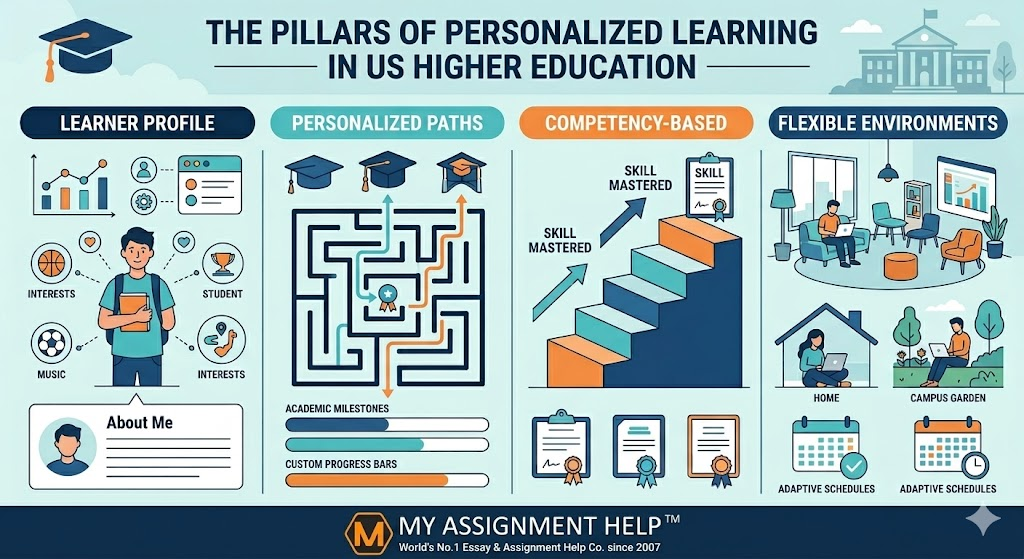
The Pillars of Personalized Learning
| Pillar | Description |
| Learner Profile | A record of the student’s strengths, needs, motivations, and goals. |
| Personalized Paths | Unique sequences of content and experiences for each learner. |
| Competency-Based | Progress is based on demonstrated mastery of specific objectives. |
| Flexible Environments | Staffing, space, and time are used shifts to support student needs. |
Frequently Asked Questions (FAQ)
1. Is personalized learning just for online students?
No. While online platforms make personalization easier, many “brick-and-mortar” US universities are implementing “flipped classrooms” where students review personalized content at home and engage in tailored discussions in person.
2. How does this impact the value of a degree?
It actually enhances it. Graduates from personalized programs often possess a more documented set of specific competencies, making them more attractive to employers who value specialized skills over general degrees.
3. Does personalized learning require more work from students?
It requires more active work. Students must take ownership of their learning path, but the relevance of the material often leads to higher motivation and less “busy work.”
Conclusion: The Path Forward
The shift toward personalized learning in US higher education is an acknowledgment of human diversity. By moving away from rigid structures and embracing a model that supports individual growth, American institutions are ensuring they remain relevant in a globalized economy. Whether through adaptive technology or specific subject-matter assistance, the goal remains the same: empowering the student to succeed on their own terms.
Author Bio
Alex Reed is a Senior Academic Strategist at MyAssignmentHelp, specializing in the evolution of digital pedagogy and SEO-driven educational content. With over a decade of experience in the US EdTech sector, Alex focuses on helping students navigate complex curricula through data-backed study strategies and customized learning resources.
References:
- National Center for Education Statistics (NCES) – Trends in Higher Education 2025/2026.
- EDUCAUSE Horizon Report | Teaching and Learning Edition.
- U.S. Department of Education – Office of Educational Technology: Personalized Learning Definitions.
